
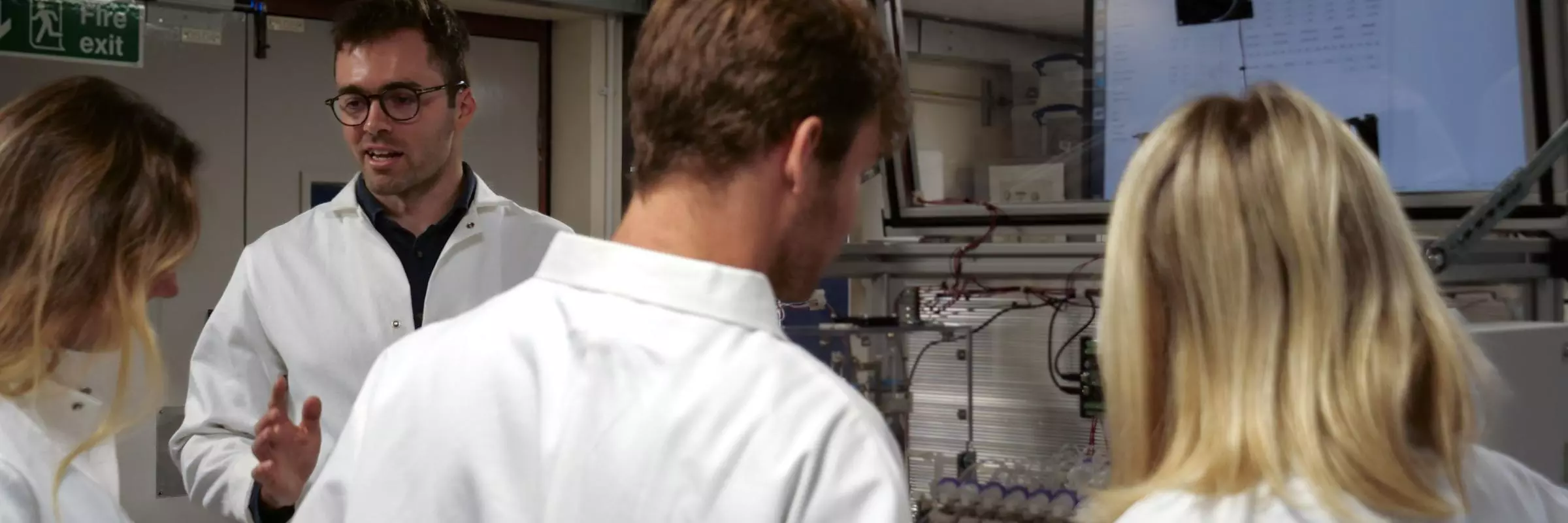
A research team that includes Harris Manchester College Fellow and Tutor in Engineering Professor Harrison Steel (pictured above on the left) has published a breakthrough study in Nature magazine
The study reports the creation of a new class of biomolecules - magneto-sensitive fluorescent proteins (MFPS) - that can interact with magnetic fields and radio waves. The interactions are enabled by the quantum entanglement of molecules within the protein and occur when the protein is exposed to light of an appropriate wavelength.
By generating and screening thousands of variants of these proteins, the research team demonstrated that their quantum properties can be engineered to create a new family of practical technologies, the first time this has been achieved. It marks a shift from observing quantum effects in nature to deliberately designing them for real-world use.
Applications of these technologies are already being explored in biomedicine. As part of the study, the team created a prototype imaging instrument with similarities to Magnetic Resonance Imagers (MRI) used in hospitals. However, unlike MRI, such instruments would be able to track specific molecules or gene expression within a living organism - key to overcoming medical challenges such as targeted drug delivery and monitoring genetic changes inside tumours.
Dr Steel, who is an Associate Professor at the Department of Engineering Science, was the senior author of the study. He commented: "Our study highlights how difficult it is to predict the winding road from fundamental science to technological breakthrough. For example, our understanding of the quantum processes happening inside MFPs was only unlocked thanks to experts who have spent decades studying how birds navigate using the Earth's magnetic field. Meanwhile, the robotic instruments used in the research were built in our laboratory but for entirely different purposes. Finally, the proteins that provided the starting point for engineering MFPs originated from the common oat - and who would have expected ahead of time that inspiration for quantum technologies could be found in a bowl of breakfast cereal?"
View the full press release on the University of Oxford website and read the study in Nature.